

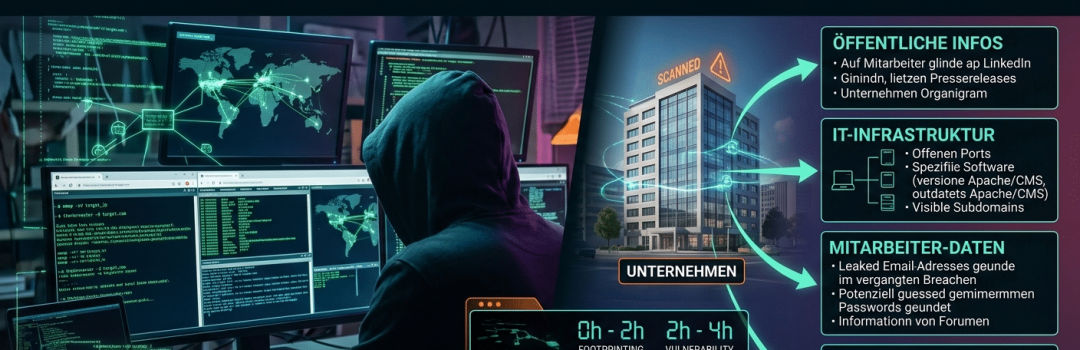
A hacker doesn't wait for your next pentest.
He searches for open systems, known vulnerabilities, misconfigurations, and compromised credentials – automated, around the clock, and increasingly today with the support of artificial intelligence.
The crucial question is therefore not:
„Have we secured our IT well?
But
„Would we recognize it if an attacker found a way into our company today?“
An automated pentest answers exactly that question.
Why traditional pentests alone are often no longer sufficient today
Many companies have their IT systems audited once a year.
That makes sense – but it’s no longer sufficient.
Because your IT is constantly changing:
- New employees are joining.
- Software is being updated.
- Cloud services are being integrated.
- New servers or virtual machines are being created.
- Permissions are changing.
- Security updates are accidentally missed.
With each of these changes, new attack vectors can arise.
A pentest from twelve months ago therefore often only describes the security situation from twelve months ago.
Cybercriminals, however, do not wait for the next scheduled security test.
You are continuously looking for new vulnerabilities.
What happens during an automated pentest?
An automated pentest simulates the actions of a real attacker – fast, continuous, and reproducible.
This isn't about collecting as many vulnerabilities as possible.
The aim is to make visible those risks that could actually be exploited.
Information Gathering – How an Attacker Learns About Your IT
Every cyberattack begins with a reconnaissance phase.
The DEFENDERBOX analyzes both internal and external systems, regardless of whether they are operated in the cloud or on-premises.
This includes the identification of:
- reachable systems
- Open ports
- running services
- Web applications
- Operating systems
- Software Versions
This creates a current picture of your actual attack surface.
Vulnerability Analysis – Where are the security risks?
In the next step, all detected systems will be automatically checked.
In doing so, the DEFENDERBOX among other things
- known security vulnerabilities (CVEs)
- outdated software
- Misconfigurations
- insecure services
- weak passwords
- missing security updates
All results are automatically evaluated and assigned to the affected systems.
Controlled Attack Simulation – Which vulnerabilities are actually exploitable?
A found vulnerability does not automatically mean a real risk.
That's why the DEFENDERBOX checks in a controlled manner whether known security vulnerabilities can actually be exploited.
Real attack techniques are simulated – naturally, exclusively within the agreed-upon test environment.
The result:
Not only theoretical vulnerabilities become visible, but also real attack paths that could allow an attacker to gain access to your systems.
Darknet Research - Are Access Credentials Already Compromised?
Many cyberattacks don't start with a technical security vulnerability.
You're starting with stolen credentials.
That's why it checks the DEFENDERBOX additionally, whether your company's email addresses or login credentials have already been published in known data breaches or dark web sources.
This way, compromised accounts can be detected and secured early on.
Prioritized recommendations instead of endless lists
At the end of the analysis you will receive a structured report.
And this is precisely where one of the biggest differences lies compared to traditional vulnerability scanners.
These often provide hundreds or even thousands of entries.
The real challenge, however, is:
Which of these security vulnerabilities pose the greatest risk to my company today?
The DEFENDERBOX therefore prioritizes the results and shows:
- which security vulnerabilities are critical
- What attack paths exist
- Which measures should be implemented first
- and what security benefit their resolution brings.
This is how a technical analysis becomes a concrete basis for decision-making for IT managers and management.
A gap is not the same as a risk.
Outdated software alone does not constitute a successful attack.
A realistic attack path only emerges when several factors come together – for example, a known security vulnerability, extensive permissions, and an accessible system.
That's precisely why it's no longer enough to simply count gaps.
The crucial thing is to understand, which security vulnerabilities can actually be exploited and what impact this would have on the company.
AI is changing the rules of the game—for attackers and defenders alike.
For a long time, automated penetration tests had a crucial disadvantage:
You worked strictly according to known rules.
An experienced pentester could identify creative attack paths, establish connections, or develop complex scenarios that classic scanners missed.
But this boundary is shifting rapidly.
Today, AI-powered systems analyze interrelationships, recognize patterns, and continuously learn from new attack methods.
However, the exact same possibilities are also available to cybercriminals.
You create deceptively realistic phishing campaigns, analyze vulnerabilities automatically, and develop working exploits significantly faster today than in previous years.
The consequence is clear:
Anyone who wants to protect themselves against modern attacks must review their IT continuously, just as attackers analyze it.
Conclusion: The most important question is not whether vulnerabilities exist
Every company has weaknesses.
What matters is not, whether they exist.
Crucially, whoever finds them first.
Cybercriminals automatically search for new attack opportunities daily.
Companies should therefore continuously review their IT from an attacker's perspective.
The DEFENDERBOX was developed for exactly this purpose.
It analyzes your internal and external IT, identifies exploitable security vulnerabilities, researches compromised credentials on the dark web, simulates real attack paths, and prioritizes the measures that will most effectively protect your company.
Because IT security doesn't start after an attack – but with knowing where attackers would strike.
Are you prepared for cyber attacks?
With the DEFENDERBOX Stay one step ahead of cyber threats: Strengthen your company's resilience against hacker attacks — not just in your own environment!
Stay vigilant – your IT stays vigilant with us!