

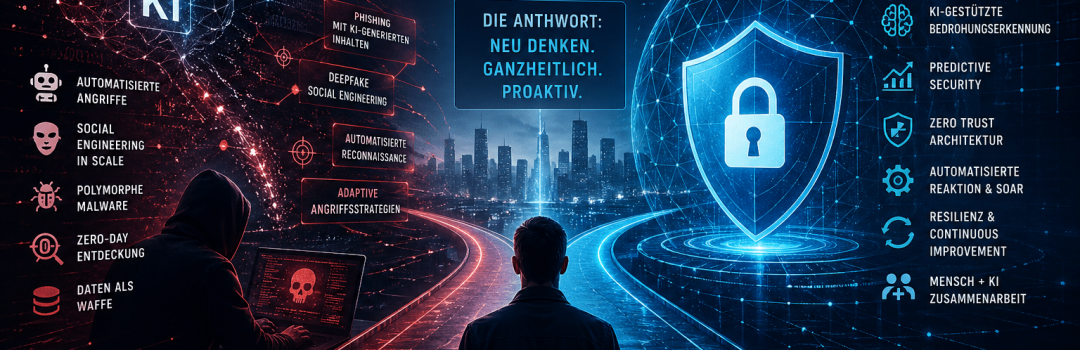
Why Cybersecurity, IT Security, and Cyber Security Need to Be Reimagined
AI is changing cyberattacks – and presenting cybersecurity, IT security, and cyber resilience with a structural problem.
The development of new AI models clearly shows how much the cybersecurity threat landscape is changing. What was once possible in isolated cases is now automated, scaled, and systematic.
A current trend: Claude Mythos (and others) are capable of independently identifying previously unknown security vulnerabilities in software.
The consequence for companies is clear:
Cyberattacks are not only becoming more efficient – they are becoming more structured and dangerous.
Cybersecurity in Transition
When machines find security vulnerabilities…
Modern AI is fundamentally changing IT security. Systems recognize patterns that are barely visible to humans, and directly transfer this knowledge into attack strategies. This specifically means for cybersecurity:
- Security vulnerabilities are identified more quickly
- Attack paths are analyzed automatically
- Vulnerabilities are deliberately combined
Real attack scenarios arise from individual security vulnerabilities.
This is increasingly shifting the balance of power in cybersecurity in favor of attackers.
The structural problem in IT security: an imbalance
As large companies continue to evolve their cybersecurity strategies, a structural deficit is emerging for many smaller organizations:
- Missing specialized security teams
- Point-in-time instead of continuous IT security measures
- Unclear transparency about existing security vulnerabilities
The actual attack surface often remains invisible, especially in medium-sized businesses.
👉 Result: A growing imbalance between offensive and defensive capabilities.
Cybersecurity in Practice: The Underestimated Basic Risks
A central problem in IT security lies not in complex attacks, but in known, unresolved fundamentals:
- Missing or Delayed Updates
- Insecure or reused passwords
- Missing two-factor authentication
- Uncontrolled use of software and applications
These security vulnerabilities have been known for years – but are often ignored in practice.
However, with AI in attack mode, the probability increases that precisely these gaps will be exploited automatically.
More software, more risk: The new reality of cybersecurity
AI today enables more and more people to develop software – quickly, easily, and without deep technical expertise.
This is a massive change for IT security:
- More applications are created in less time
- Security checks are often skipped
- New security vulnerabilities are constantly emerging.
More software inevitably means more attack surface.
Secure software isn't created automatically—it must be an active part of the cybersecurity strategy.
Rethinking IT security: Why cybersecurity is an ongoing process
A common misconception:
IT security is understood as a state, not a process.
The reality in cybersecurity, however, is:
- IT environments are constantly changing
- New security vulnerabilities are constantly emerging
- Attack strategies are continuously evolving.
👉 Cybersecurity is dynamic – and must be treated the same way.
Once implemented, security solutions are not enough to guarantee long-term protection.
Cybersecurity in Practice: What Companies Should Do Now
To sustainably improve one's own IT security, two levels are crucial:
Implement foundational cybersecurity practices consistently.
- Use secure, unique passwords
- Use a password manager or passkeys
- Enable two-factor authentication
- Ensure regular updates and patch management
- Consistently remove unnecessary software
2. Create transparency about security vulnerabilities
- Which systems are actually vulnerable?
- Where are the specific security vulnerabilities?
- Which protective measures work – and which don't?
Without transparency, there is no effective cybersecurity.
Conclusion: Cybersecurity, IT security, and cyber security need a new understanding!
The use of AI in cybersecurity is not a distant dream – it is already changing the reality of attack and defense today.
As attacks become more intelligent, faster, and scalable, IT security in many companies remains reactive and fragmented.
The crucial skill of the future is therefore not: using more tools.
But
to understand one's own attack surface
Recognize security vulnerabilities in context
and continuously review cybersecurity
Only those who have true transparency about their IT security can act strategically.
Are you prepared for cyber attacks?
With the DEFENDERBOX Stay one step ahead of cyber threats: Strengthen your company's resilience against hacker attacks — not just in your own environment!
Stay vigilant - your IT will stay that way with us!