

What is the difference, exactly?
Anyone who is new to the topic of IT security or IT security testing quickly encounters three terms that are often used synonymously but mean different things:
- Penetration test (Pentest)
- Vulnerability scanner
- automated security check
The confusion is understandable – all three deal with the same underlying problem, but approach it very differently.
The vulnerability scanner: the inventory
A vulnerability scanner searches systems, networks, and applications for known vulnerabilities – usually by matching them with public databases such as the CVE list.
The result is a list: which software is outdated, where patches are missing, and which configurations deviate from best practices.
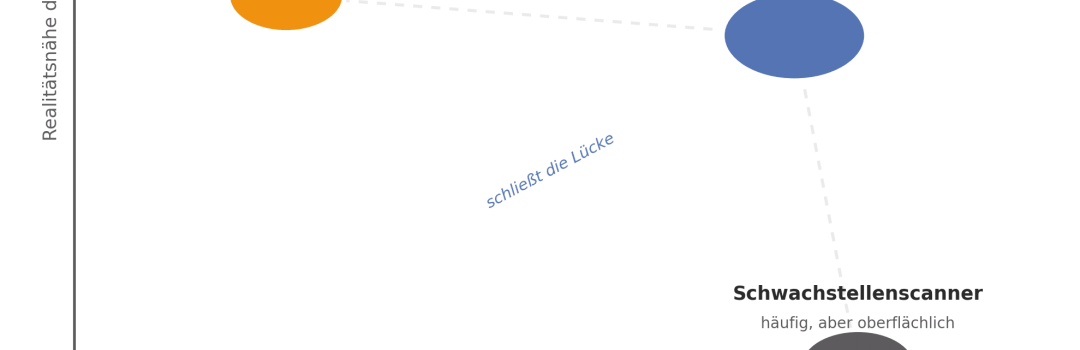
The scanner is fast, inexpensive, and can often be repeated. Its limitations lie in the fact that it only considers individual vulnerabilities in isolation. Whether several, individually uncritical gaps can result in a truly exploitable attack path cannot usually be assessed by a pure scanner.
The classic penetration test: the simulation
A manual penetration test goes one step further. Here, human security experts actively attempt to break into a system – just as a real attacker would do.
Not only are known vulnerabilities exploited, but also combinations thereof, social engineering or configuration errors.
The pentest thus provides a significantly more realistic assessment of the actual risk. The price for it: it is time-consuming, expensive, and limited in scope. A pentest shows the state of a system on a specific day – already a week later, the initial situation may have changed due to new software, new employees, or new vulnerabilities. Therefore, in practice, it rarely takes place more often than once or twice a year.
The automated IT security review: the bridge between the two
Here comes a third category that tries to combine the strengths of both approaches.
An automated security check simulates – similar to a pentest – real attack techniques and actively checks whether individual vulnerabilities can be combined to form a real attack path.
The decisive difference: This process runs automatically and can therefore be repeated as often as necessary without the need to book an external expert team every time.
The result is not just the discovery of individual vulnerabilities like with the scanner, but an assessment of which combinations of these are actually exploitable – combined with the possibility of repeating this examination regularly, perhaps weekly.
Which approach is appropriate at which time?
For many organizations, the answer is not a binary choice. A vulnerability scanner is well suited for ongoing basic monitoring. A classic pentest remains useful when particularly critical, complex systems need to be examined in detail and with human expertise.
An automated security check bridges the gap: it provides a significantly more realistic assessment than a simple scan, but is often repeatable enough to be practical for compliance obligations such as NIS2 or insurance requirements.
Are you prepared for cyber attacks?
Stay vigilant – your IT is with us!
Image generated by AI